
Managing Director's Overview

The year 2011, as we predicted in 2010, showed real maturity in the voice business. Although voice usage still increased substantially as a result of the drop in price per minutes in a competitive environment, revenues slightly dropped by 1%.
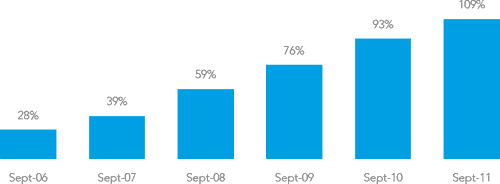
Penetration in Namibia has now passed 108% consisting of 1,854,700 active MTC customers (active sim card that made any communication even that was chargeable in the past three months) and an additional 435,000 for the other Mobile Operators.
Despite the mentioned slight decrease in voice call revenues, SMS and mainly data usage (mobile internet access) grew by two digits in revenues, due to the significant usage of both services. Message usage increased by 24% during the reviewed 12 months, where the average MTC customer sent more than 400 messages per month. We believe this is the highest-level usage in Africa resulting from the free SMSs in several post and prepaid packages. Data usage, result of the strong demand of Internet access doubled usage during the year ended 30 September of 2011.
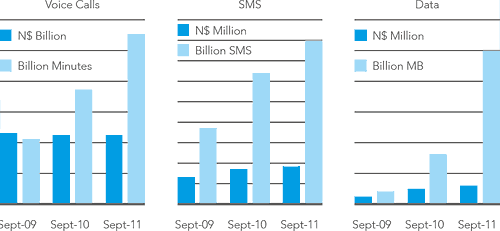
Data is gaining more momentum as a result of the investment in an advanced network and the commercial activities around our NetMan product that enhanced our focus since June 2010.
More than 80,000 customers accessed the Internet through a PC or tablets and over 470,000 via their mobile phones, giving us close to 550,000 users accessing Mobile Internet from various platforms.
On the other hand, another revenue impact was the final drop of mobile termination rates finalised in January 2011, concluded the "glide path" decided by the Namibia Communications Commission in January 2009. The rate is now N$0.30, which is third lowest in the SADC Region after Mauritius and Seychelles.
All in all, performance was solid in 2011 with total revenue growing 3.2% at N$1,454.7 million (N$1,409 million last year), and an EBITDA level of N$774,1 million, down 1.5% from last year (N$785,8 million).
The Market
The penetration rate of over 108%, according to our estimates, points to the fact that our subscribers regularly use multiple SIM cards or because they use more than one cellphone (private and business) or use it on different platforms; i.e. cellphone, laptop and tablets. This ultimately generates multiple usages of our services, which are very important.
MTC has also developed reliable and affordable mobile alternatives to traditional fixed line services. These solutions include HomeZone and NetMan Home, as well as SME's solutions under the OfficeBox brand catering to single voice and Internet.
Our commercial price strategy to the prepaid segment included the introduction of T49 with 38c per minute, adding to the range of the prepaid products together with Aweh-Aweh and others. BlackBerry® Smartphone solutions for postpaid and prepaid were both introduced during the course of the year. These active actions, amongst others, contributed to MTC maintaining its market share.
Finally highlighting the competition, according to its press release of June 2011, our international competitor Orascom, owner of Powercom (Pty) Limited, operating under LeoTM, has finalised an agreement with two banks, for the sale of Powercom.
The Regulatory Environment
The new Telecommunication Act, 2009 commenced in May 2011 with the introduction of the new Commission Regulatory Authority of Namibia (CRAN). MTC applauds the new Act and beliefs that CRAN will act in the best interest of the industry. However, before the transition period, MTC assisted and tried to defend our position on some changes introduced by the former authority, the NCC.
In a nutshell, after the completion of the mentioned glide path of Mobile Termination Rates - the rate that a mobile operator charges to terminate a call in its network originated in other network - the NCC presented new challenges concerning the rates that operators charge to its customers.
This decisive retail intervention was a price cap for off-net call prices at the same level as on-net prices, and this applied to voice and text messages. Furthermore, the NCC decided that if for a certain period an operator zero-rated on-net, minutes or text messages, then the operator needed to zero-rate off-net as well, despite the need to pay a termination rates to the other operator.
MTC believes that the NCC did not follow the proper procedures to intervene in retail prices, and even if it had taken the proper procedures, the decision taken is unprecedented in the industry, and ended up hurting competitors, and possibly future consumers. In reality it was three months after the intervention that the mentioned International competitor sold the company to the creditors with the liability (according to the mentioned press release). Nevertheless, Namibia has now one of the tightest price regulations in the world.
The second aspect that affected MTC regarding regulation is the authorization of base stations. After a lengthy period of public consultations and moratoriums, MTC was not able to develop the direly needed new base stations in the capital. MTC used an international entity to conduct a test to determine what the level of electromagnetic fields from MTC's base stations was, and also appointed a renowned scientist in order to validate the findings.
The result was that the radiation in the worst-case scenario was 90% below the levels defined by International Communication of Non-Ionising Radiation Protection (ICNIRP), an organization belonging to the World Health Organization (WHO). We will continue to maintain our efforts in order to sensitize the public and the authorities of what we did and also the need of developing additional base stations.
Strategic posturing
Our strategy's focus is always on retaining current customers and being proactive in acquiring new ones. Data is an additional focus and we have therefore invested tremendously in network capability and international Internet connectivity.
During the year in review, MTC completed a public real trial of 4G-LTE (Long Term Evolution) technology, the second in Africa, with speeds 10 times faster than current 3G technology.
4G is a multi-band spectrum technology, which means it allows different bands of frequency; depending on what area we will deploy it in. As a result, this technology can be deployed in rural as well as urban areas; using lower frequencies with a bigger radius in rural, covering long distances, and higher frequencies that will have lower radius, minimizing interferences in urban. 3G utiliz es a single-band spectrum with a high frequency over a smaller area limiting its reach, therefore it's only possible to be used in urban areas.
MTC also invested US$ 15 million towards the WACS (West African Cable System) submarine cable, connecting Namibia to Europe, not to mention the vast investment efforts to transit that submarine cable from the coast to all areas of the country. For this, an agreement was reached to use fibre optic cable over power lines to ensure reliability and protection of the asset.
These investments in infrastructure means that MTC is not only leading in introducing 4G-LTE technology, but is also developing advanced solutions that will revolutionize efficiency in corporate telecommunications. In this light, MTC applied for a fixed line license in June 2011 and we are positive that it will be awarded as soon as the new Act is completely in place.
Parting Thoughts
MTC believes in ensuring our staff remain customer focussed at all times. This is a daily challenge across all customer interactions with us. From the Call Centre, MobileHome stores, Key Accounts, to our switchboard, website, e-mails and letters we receive; our customers expect only the best from us.
Having the most advanced technologies will not mean anything unless customers recognize the benefits of it and choose MTC as their preferred network. In this regard, we need to stay focussed on our customers needs and use our advanced technology to make their lives better. By constructing these two pillars well, we will continue to be leading telecommunications entity in Namibia.